
Key takeaways
- You can start a UK mobile detailing side hustle for roughly £450 to £900 if you already own a car, covering kit, consumables and public liability insurance.
- A full valet takes a solo detailer 2.5 to 4 hours, so price backwards from your hourly rate: £80 to £100 is a defensible starting price for a full valet.
- Take a deposit at the time of booking through one booking link in your Instagram bio to stop no-shows eating your weekend slots.
- Two full valets a Saturday at £80 to £100 each brings in £640 to £800 a month before fuel and product costs, and repeat maintenance washes make it sustainable.
- Once gross self-employed income passes £1,000 in a tax year, you must register for Self Assessment with HMRC.
Is car detailing a good side hustle in the UK?
Yes, for the right person: a mobile detailing side hustle needs low startup costs, flexible hours, and demand that already exists on your street, but it competes badly with your day job if you let bookings run your evenings.
What works in your favour as a mobile detailer
You travel to the customer, so you skip premises costs. Your diary fills around your week: Saturday full valets, one evening job midweek. Demand is steady because every car gets dirty again. And getting paid is simple: customers pay a deposit from a booking link like the one DetailersEye gives you, so the slot is held before you drive anywhere.
What makes it hard alongside a day job
No-shows burn your only free weekend slots, which is why deposits matter (see how to stop no-shows). Admin creeps in too: once your gross income from self-employment passes £1,000 in a tax year, you have to register for Self Assessment. Budget your energy, not just your hours.
How much does it cost to start a mobile detailing side hustle?
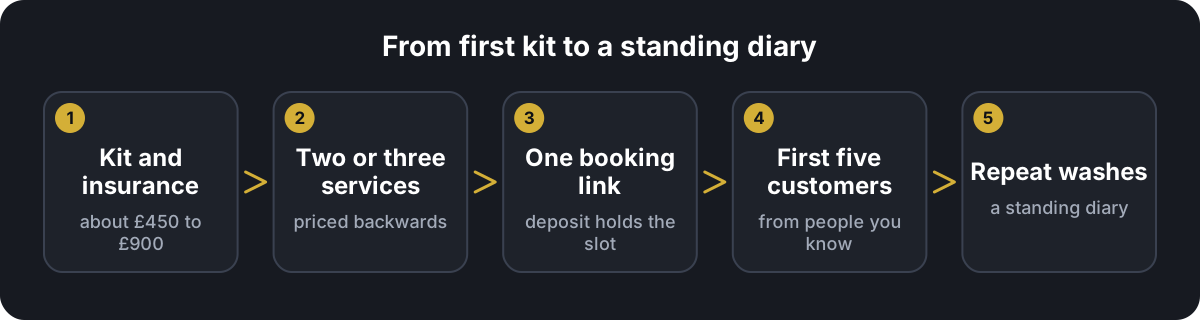
You can start a mobile detailing side hustle in the UK for roughly £450 to £900 if you already have a car. That covers basic kit, your first consumables, and insurance. Anything above that is optional until paying customers prove the idea.
Starter kit: illustrative cost breakdown
The figures below are illustrative, not quotes. Prices vary by brand and where you buy.
| Item | Illustrative cost |
|---|---|
| Pressure washer | £100 to £180 |
| Wet/dry vacuum | £60 to £120 |
| Buckets, grit guards, wash mitts | £30 to £50 |
| Drying towels, microfibres | £25 to £40 |
| Chemicals: snow foam, shampoo, APC, wheel cleaner | £60 to £100 |
| Interior kit: brushes, APC, glass cleaner | £30 to £50 |
| Wax or sealant | £25 to £50 |
| Public liability insurance (annual) | £100 to £300 |
| Total | £430 to £890 |
Running costs people forget
Fuel is the obvious one, but it is rarely the biggest. Watch for replacement consumables each month, phone data if you book from the road, card or bank transfer admin, and the time cost of chasing no-shows who never paid a deposit. A full valet that uses £5 to £10 of chemicals still needs to clear your hourly rate, so price against your time, not your products. For a worked example, see how to price a mobile detail.
How much time does a detailing side hustle actually take?
Plan on 8 to 12 hours a week once you have a handful of regulars: 4 to 6 hours doing the work on a Saturday, 2 to 3 hours travelling and setting up, and an hour or two replying to DMs, chasing deposits and updating your diary in the evening.
A full valet is not a 60-minute job
A full valet inside and out runs 2.5 to 4 hours for a solo detailer, and a correction or ceramic job takes a whole day. Budget travel time between jobs too, because a mobile setup lives or dies by how much of the day you spend driving.
Insurance is a fixed admin cost rather than a time sink, but get it sorted before your first customer. Public liability cover for a solo mobile detailer commonly costs somewhere around £100 to £300 a year depending on the cover level, so get a few quotes and read what is excluded.
What kit do you need before your first paying customer?
Your minimum viable kit fits in a car boot: a pressure washer, a wet/dry vacuum, microfibre cloths, buckets with grit guards, APC, snow foam, wheel brushes, and a drying towel. Buy mid-range brands, not pro-grade, because your first few full valets will tell you what you actually use. Around £300 to £600 covers the kit itself if you already own an extension lead.
Buy later, not first
Skip the polisher, steam cleaner, and van racking until customers ask for them. A machine polish is a paid job you sell once you can deliver it safely, not a purchase you make on day one. The same logic applies to admin: a spreadsheet works for five customers, but once bookings come through Instagram DMs and WhatsApp, a booking link with deposits stops no-shows before they happen. We built DetailersEye around that problem, and the free plan covers your first month of bookings. More on that in our guide to taking bookings from Instagram.
How do you get your first five customers?
Your first five customers come from people who already know you, not from ads. Post a before-and-after of your own car, then your mate's car, then your first paid job. Put a booking link in your Instagram bio and pin it to your WhatsApp status so anyone who sees the results can pick a slot and pay a deposit straight away. A simple setup like DetailersEye handles that link and the deposit without a monthly cost while you're starting out.
Instagram and WhatsApp as your storefront
Treat your profile as your shop window: three or four strong before-and-afters, your service area in the bio, and one way to book. When someone DMs "how much for a full valet?", reply with a photo of your work and the booking link rather than a paragraph of pricing. Bank transfer after the job leaves you exposed; a deposit before it protects your Saturday.
Asking for the review, not just the payment
Reviews beat ads at this stage, so ask for one while you're still packing up. Send the Google review link with your thank-you message the same day, when the shine on the bonnet is still fresh. Five reviews from real cars in your postcode will do more for your next five bookings than any paid post.
How should you price a side-hustle detail?
Price backwards from your costs, not forwards from what feels cheap. A full valet takes most solo detailers 2 to 4 hours, so your hourly rate has to cover fuel, products and your time on top.
Worked example, using illustrative numbers: chemicals, mitts and towels for a single full valet typically cost £3 to £8, and a mobile round trip adds roughly £5 to £10 of fuel. If a full valet takes 3 hours and you want £20 an hour for your time, that is £60 for your time plus £8 to £18 of costs, so roughly £70 to £80 before any profit. A starting price of £80 to £100 is defensible, not greedy.
Two rules: never quote per hour to customers, and raise prices after every five fully booked weekends. Underpricing is the most common reason side hustles die.
How do you stop no-shows eating your weekend?
A no-show costs you a slot you could have sold, and as a solo detailer you have nobody to cover it. The fix is simple: take a deposit at the time of booking. Someone who has paid £20 towards a full valet turns up; someone who said "see you Saturday" in WhatsApp sometimes doesn't.
Deposits also filter out time-wasters before they reach your diary. The easiest way to do this is one booking link in your Instagram bio: the customer picks a service, pays the deposit, and the slot is held. DetailersEye does exactly this, with no platform fee on bookings and a free plan with no time limit, so you can start before your first paying customer.
Your first 90 days: a week-by-week launch plan
Weeks 1 to 2: kit and pricing
Buy the basics, pick two or three services (a maintenance wash and a full valet), and set prices that clear £20 to £25 an hour after fuel and products. Check how you'll handle wash-off water before your first job: the Environment Agency expects dirty water not to enter surface water drains or watercourses (see the GOV.UK pollution prevention guidance).
Weeks 3 to 6: first bookings
Post before-and-afters on Instagram and WhatsApp status, message everyone you know, and offer a launch discount to the first five customers. Take bookings through one link and take a deposit, so a "yes" in the DMs actually holds the slot.
Weeks 7 to 12: reviews and repeat work
Ask every customer for a Google review the same day, and offer a 4-week recurrence on maintenance washes. By week 12 you want a diary that's half repeat bookings, not a feed of one-off jobs.
The single thing that decides whether this side hustle survives is turning one-off customers into a standing diary. A full valet is nice money once; a customer who books you every four weeks is a business. So from day one, price the maintenance wash low enough to say yes to, finish every job by asking "shall I put you in for next month?", and record it before you leave the driveway. Deposits, reviews and recurrence aren't admin chores, they're the whole model.
When does a side hustle become a full-time business?
Three signals, roughly in order: your diary is full four weeks out, you are turning down Saturday work, and the spreadsheet is costing you more evenings than the valeting does. If you are booking out most weekends and still covering your costs after kit, fuel and products, the demand is there.
What changes: you track income properly for Self Assessment, you raise prices so a weekday slot earns like a Saturday one, and you stop taking bookings through DMs because a missed message is now a missed mortgage payment. A booking link with deposits becomes less about no-shows and more about protecting a full-time diary.
Sources and further reading
- GOV.UK: Working for yourselfWhen working for yourself means reporting income to HMRC, and where to start.
- GOV.UK: Tax-free allowances on property and trading incomeThe £1,000 trading allowance, and why gross self-employed income above it means registering for Self Assessment.
- GOV.UK: Pollution prevention for businessesWhy vehicle washing wastewater is trade effluent, why surface water drains must only take clean water, and the foul drain and waste carrier options.
Common questions
Can you make £500 a month detailing cars on weekends?
Yes. Two full valets on each of four Saturdays at £80 to £100 each brings in £640 to £800 before fuel and products. Add a couple of maintenance washes at £30 to £40 and you clear £500 after costs more comfortably. The constraint is your diary, not demand: repeat customers make the target sustainable rather than a one-month spike.
Do I need a licence or insurance to wash cars for money in the UK?
No specific licence is required for mobile valeting, but get public liability insurance before your first customer, which commonly costs around £100 to £300 a year. Once your gross self-employed income passes £1,000 in a tax year, you must register for Self Assessment. Also check how you handle wash-off water under the GOV.UK pollution prevention guidance.
How many cars can one person detail in a day?
Two full valets is realistic for a solo detailer, since each runs 2.5 to 4 hours plus travel and setup. Three is possible if the cars are small and close together, but quality slips. A correction or ceramic job means one car for the whole day. Plan Saturdays around two solid jobs.
Is it worth buying a pressure washer or should I start with a hose?
Buy the pressure washer. A basic domestic unit typically costs around £100 to £150, and it is the single biggest time saver in the kit: snow foam clings properly and rinsing takes minutes instead of half an hour per car. At two jobs a Saturday, it earns its cost back quickly.