
Key takeaways
- Buy equipment to match the packages you sell: interior-only work needs a wet/dry vac, extractor and steam cleaner, while exterior work needs a pressure washer, water tank and power.
- A workable starter kit costs around £400 to £700, covering a full valet using the customer's outdoor socket and tap for power and water.
- Skip polishers, ceramic kits and generators until the relevant packages are selling weekly, since unused gear ties up cash.
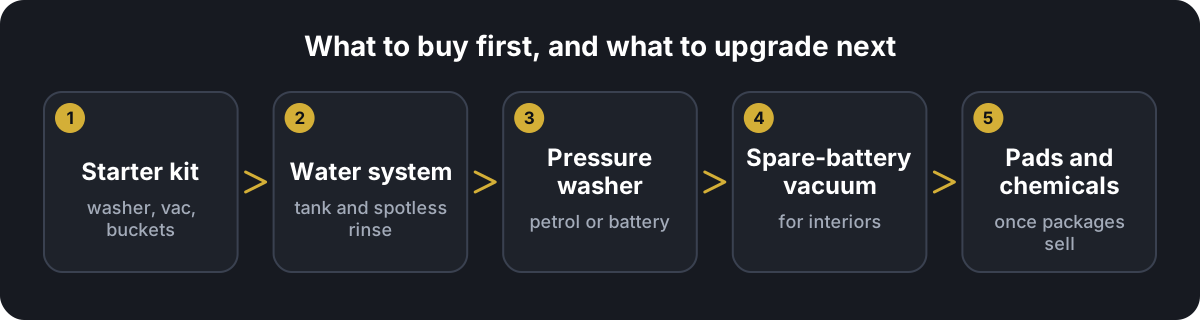
- Upgrade in order: water tank and spotless rinse first, then a petrol or battery pressure washer, then a spare-battery vacuum.
- A portable power station with a pure sine wave inverter, around 1,000 to 1,500Wh with a 1,800W output, covers most solo detailing sessions.
What equipment is needed for a mobile car detailing starter kit?
A starter kit covers three jobs: washing, extracting, and powering it all from your van or driveway. Everything else is an upgrade you buy once bookings justify it.
The non-negotiables
You need a pressure washer (a 110 to 130 bar electric unit is enough and quieter for residential streets), a wet/dry vacuum for interiors, two buckets with grit guards, wash mitts, microfibre towels, and a basic chemical set: snow foam, wheel cleaner, APC, and an interior dressing. Add a 25m hose and a brushless drill with attachments if you plan to do interiors properly.
What you can skip at the start
Skip the generator entirely if you're doing washes and interiors: most UK driveways have an outdoor socket or you can run a hose from the customer's tap. Skip polishers, ceramic coatings, and a water tank until full details are selling weekly. A basic wet/dry vac starts at roughly £60 and a decent electric pressure washer at roughly £90, so a workable core kit lands near £300 to £450 before chemicals. Prices change, so check current prices before you buy.
Once the diary fills, sort out how bookings arrive too. The free guides at DetailersEye cover moving off DMs and spreadsheets.
How does the equipment list change for interior-only versus full-detail services?
Your kit should match the packages on your menu, not the other way round. Buying for a full detail when you only sell interior work ties up cash in gear that sits in the van. Map the kit to each package first, then price the packages so they cover what each one actually uses.
Interior-only package kit
Interior work needs no water tank and no generator, which is why the interior-only package is the cheapest to start. You need a wet/dry vacuum, a low-moisture extractor or upholstery cleaner, steam cleaner, interior brushes, microfibre cloths, all-purpose cleaner, glass cleaner and an air freshener. Most of the kit runs off the customer's socket or a power bank, so you can work from your car or theirs.
Exterior-only package kit
Exterior work is where power and water get serious. You need a pressure washer, a foam lance, wash buckets with grit guards, wash mitts, drying towels, wheel brushes, tyre dressing, and a snow foam or shampoo. If the customer has no outdoor socket, you will need a generator or a battery-powered pressure washer, and a water tank if you cannot use theirs.
Full detail: the combined kit
A full detail is both kits in one van, plus the extras that come from doing interiors and exteriors in the same visit. The table below shows what each package actually requires.
| Item | Interior-only | Exterior-only | Full detail |
|---|---|---|---|
| Wet/dry vacuum | Yes | No | Yes |
| Extractor or steam cleaner | Yes | No | Yes |
| Pressure washer + foam lance | No | Yes | Yes |
| Water tank / generator | No | Usually | Usually |
| Interior brushes and chemicals | Yes | No | Yes |
| Wash mitts, towels, sealant | No | Yes | Yes |
Once your kit matches your menu, the next job is filling the diary. A booking link with deposits cuts no-shows, and the free plan at DetailersEye covers the early days without a monthly bill.
What power and water setup do you need when working without a shop?
Most driveways have no outdoor socket, so you need power that travels with you. A portable power station with a pure sine wave inverter output is the safe option for running a pressure washer, vacuum, and polisher without risking damage to their motors. Battery capacity, not brand hype, decides what you can run: check the watt-hour rating against the rated draw of your tools before you buy. Manufacturers' spec pages list inverter type, watt-hour capacity, and continuous output for each unit, so you can match a station to your actual kit rather than guessing. A 1,000 to 1,500Wh station with a 1,800W inverter covers most solo detailing sessions; anything less and a full valet will flatten the battery before the interior is done.
Water is the other half of the problem. A 100 to 200 litre tank in the van, filled at home, covers two to three full details. Pair the tank with a 12V pump for steady feed to the pressure washer, and use a simple inline carbon filter or deionising resin cartridge for the final rinse so glass and paint dry spot-free. Budget detailers start with a single tank and jerry cans; upgraded setups add a second tank for rinse water only.
If you are pricing jobs around what each setup costs you per wash, the maths belongs in your quotes, not your head. The guide to pricing a mobile detail walks through it.
How much should a new mobile detailer budget for equipment in each tier?
The budget totals below are illustrative, worked from typical UK retail prices, so treat them as planning figures rather than quotes. Prices change often.
Starter, around £400 to £700: a domestic pressure washer, two buckets with grit guards, a wet/dry vacuum, interior brushes, microfibres, and chemicals for one service, say a full valet. You already own the van and your phone, so the starter kit covers everything a first booking needs.
Mid tier, around £1,200 to £2,000: add a petrol or battery pressure washer, a water tank or waterless system, a polisher, a generator or inverter, and enough stock to run interior-only and exterior-only packages as separate services.
Pro tier, £3,500+: a dedicated van build, a larger tank, a dual-action and rotary polisher, a steamer, and a hot water setup.
Kit bought for the business is usually a business expense. GOV.UK explains which costs sole traders can deduct, including capital allowances for equipment.
Whichever tier you start at, protect the spend: a deposit taken at booking pays for chemicals before the job, which is exactly the no-show problem covered in the guide to no-shows and deposits.
Which mobile detailing equipment is worth upgrading first as revenue grows?
Upgrade order for a solo detailer
First upgrade: a proper water system. A baffled tank in the van plus a spotless rinse setup kills the biggest time sink, fetching and hauling water, and a pure-water final rinse cuts drying time on every full valet. Tank sizes and filtration setups vary widely in capacity and price, so match the tank to your typical day rather than buying big early.
Second: a petrol or battery pressure washer so you are not hunting for the customer's outdoor socket. Third: a wet/dry vacuum with a spare battery, then better pads and chemicals once you know which packages actually sell.
When an upgrade does not pay
A polisher is the classic early mistake. If most of your bookings are interiors booked through DMs, a rotary sits in the van earning nothing. The same goes for a second extraction machine or a van wrap before your diary is full. Fix no-shows and deposits first; a tool that fills empty slots beats a tool that shaves minutes. Keep the booking link simple so the upgrade pays for itself (see how our booking pages handle accessibility).
Where can you find reliable mobile auto detailing equipment for sale?
UK mobile detailers have three main channels: trade suppliers such as car care wholesalers and pressure washer dealers, general marketplaces like Amazon UK and eBay, and local classifieds (Facebook Marketplace, Gumtree) for second-hand kit. Trade suppliers cost more upfront but give you warranty support and consistent stock when a lance or vacuum breaks mid-week. Marketplaces suit one-off buys; just check delivery weight, because a 20kg pressure washer plus accessories can double the price.
New vs used: what to check
For used pressure washers, ask for the model number and confirm spare parts availability before paying. Test the pump under load, inspect the hose for cracks, and check the plug and RCD for damage. Used wet vacs are usually safe buys if the motor runs quietly and the tank has no hairline cracks. Anything electrical you cannot test in person is not worth the saving.
Once the kit is sorted, budget a small amount for presentation: a set of business cards with your booking link printed on them costs roughly £10 to £20 from an online printer, and gives DM contacts something physical to stick on the fridge.
Do you need business cards and printed materials alongside your equipment kit?
Barely. Your booking link does the work a card used to: it holds the diary, takes the deposit, and stops no-shows in a way a phone number on card stock never could. A card can't take a £20 deposit; a link can.
The cheap middle ground is a QR code. Print the code on a single magnetic sign for the van door and a small card you hand over after a full valet, pointing at your booking link. One print run, roughly under £30 at most online printers, keeps working when you are elbow-deep in an interior.
Skip flyers, brochures, and anything with prices that will change. If you are still booking through DMs and bank transfer, spend the £30 on the sign first, then put everything else into the kit itself.
Sources and further reading
- GOV.UK: Expenses if you're self-employedWhich business costs, including travel, a sole trader can deduct when working out taxable profit.
- GOV.UK: Working for yourselfWhen working for yourself means reporting income to HMRC, and where to start.
Common questions
Can I start a mobile detailing business with £500 of equipment?
Yes. A starter kit with a domestic electric pressure washer, two buckets with grit guards, a wet/dry vacuum, brushes, microfibres and chemicals for one service lands around £400 to £700. At £500 you cover a full valet, and the customer's outdoor socket and tap handle power and water until bookings justify upgrades.
Do I need a van for mobile detailing, or can I use a car?
A car works for interior-only packages, since that kit needs no water tank or generator and most of it runs off the customer's socket or a power bank. Exterior work changes the maths: tanks, pumps and pressure washers get heavy, so most detailers move to a van once full details are selling weekly.
What generator size do I need for a pressure washer and vacuum?
Check the rated draw of each tool first, then buy capacity above the combined total. For most solo setups, a portable power station with a pure sine wave inverter, around 1,000 to 1,500Wh with a 1,800W inverter, covers a session. Anything smaller and a full valet will flatten it before the interior is done.
Is it cheaper to buy mobile detailing equipment as a bundle?
Usually not. Bundles often include items you would skip early, like polishers or ceramic coating kits, tying up cash in gear that sits unused. Buying separately lets you match the kit to the packages you actually sell, pick quality where it matters, and grab second-hand bargains on marketplaces or local classifieds.