
Key takeaways
- A full valet from a UK mobile detailer should cost roughly £50 to £100 for a standard car in 2026, with wash-and-vac work from about £25 and mini-details from about £120.
- Vehicle size and condition move the quote most, so price by size tier and named condition add-ons like pet hair or biohazard rather than one flat rate.
- Mobile valeting costs more than hand-wash sites because one person's full attention replaces a site's throughput, and every travel mile is unpaid time unless priced in.
- A defensible quote states what is included, the vehicle size band, the deposit, the travel terms and a written final price before arrival.
- Publishing a starting price list with "from £X" tiers on one booking link lets customers self-select and cuts no-shows when paired with a deposit.
How much should car valeting cost in the UK in 2026?
Most UK mobile valeters land in these bands in 2026. Treat them as illustrative starting points, not quotes: your area, the vehicle's size and its condition move the numbers.
| Service | Typical 2026 range | What it covers |
|---|---|---|
| Wash-and-vac | £25 to £45 | Exterior wash, interior vacuum, wipe-down |
| Full valet | £50 to £100 | Deep interior clean, paintwork, tyres, windows |
| Mini-detail | £120 to £250 | Machine polish or paint enhancement, sealant, deeper interior work |
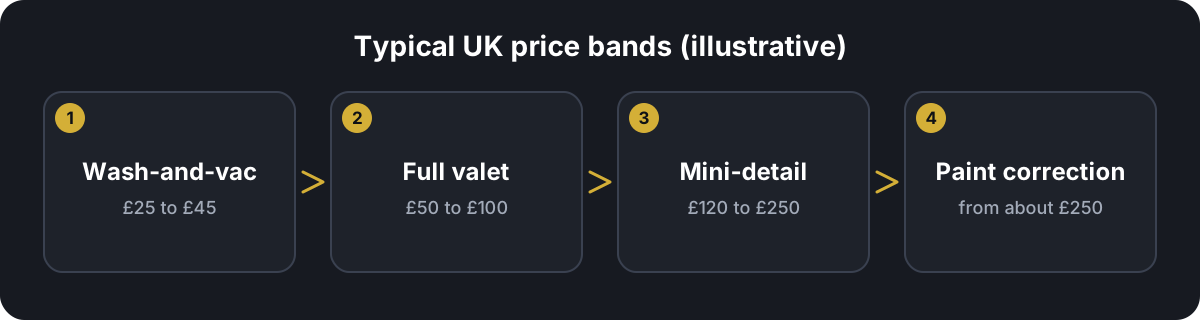
A car valeting prices list you can sanity-check against
If your full valet quote for a family SUV sits at £50, check it against your hours. A valet that takes three hours, plus travel, fuel and products, has to clear your hourly rate, or you are quietly working for less than you think.
If you want a worked method rather than a guess, we break down labour time, product cost and travel into a defensible rate in how to price a mobile detail.
Why any single national figure is a rough guide only
Larger cities and the South East can support higher rates, because customers expect it and your own costs are higher. A van with a water tank and generator carries more overhead than a setup using the customer's supply. And a mud-caked work truck takes twice as long as a weekly hatchback, so price the job, not the service name.
What is the difference between a valet, a detail and a wash-and-vac?
A wash-and-vac is a maintenance clean: exterior wash, wheels, interior vacuum, wipe-down of touch points. On a typical family car, that is 45 to 60 minutes. A full valet goes further: deep clean of upholstery and carpets, door shuts, trim dressing, and usually a hand-finished exterior. Expect 2 to 4 hours. A detail is correction work, not cleaning: paint decontamination, machine polishing to remove swirls and scratches, then protection. Details run 6 to 12 hours or more, often across two days.
What a full valet should include for the money
A full valet price should cover: interior deep clean including seats and carpets, glass inside and out, door shuts, boot, exterior hand wash with wheels and tyre dressing, and a paint-safe drying method. If a detailer quotes a full valet but skips shuts and glass, the price is not comparable to someone who does both.
The price gap between tiers is legitimate because it tracks hours on the vehicle and consumables, not guesswork. A solo detailer quoting £25 for a wash-and-vac, £60 for a full valet and £250 or more for a detail is simply pricing time. Publish your tiers with what each includes on a single booking link, and customers self-select instead of negotiating in DMs. DetailersEye lets you list each service with its own price and deposit on one link, so a quoted price matches what the customer actually pays.
Why do mobile car valeting prices differ from hand-wash site prices?
A mobile valet costs more per job because you're paying for one person's full attention, not a site's throughput. A hand-wash site spreads rent, water, power and staff wages across dozens of cars a day. A mobile detailer carries all of that alone, one van at a time, so the higher price reflects that structure, not padding.
What your travel radius does to a quote
Every mile is unpaid time. Drive 25 minutes each way for a £40 job and you've spent an hour not earning, plus fuel. Detailers who quote flat prices citywide end up subsidising the far jobs with the near ones. Two fixes work: quote a base radius, then add per-mile beyond it, or price travel into the job from the start.
If you take bookings through DMs and bank transfer, quoting travel as a visible line item also cuts no-shows, because the customer sees what the slot costs before they commit. DetailersEye lets you publish a booking link with a deposit attached, so the diary holds. The free plan covers 30 bookings a month, which suits a solo detailer starting out. Where it falls short: it won't route you between jobs or optimise your driving day, so a wide radius still costs you the miles. More pricing guides live in the guides section.
Are supermarket car park valeting services cheaper than independent valeters?
Yes on the sticker, usually not once you look at what is included. Car park valeting is often advertised at roughly £10 to £20 for an exterior hand wash with a quick interior vac, while an independent mobile full valet typically costs more because it covers paintwork, carpets, glass and trim properly. Treat those figures as illustrative: prices vary by site and change often.
What a £10 to £15 car park valet actually buys
At that price you get one person, one bucket, twenty minutes and whatever products are in their trolley. There is rarely a defined checklist, so two visits can mean two different results. Add-ons appear fast: tyre dressing, boot clean, pet hair removal, each a few pounds more, and the final bill can double.
An independent quotes one price for a defined job. If you publish your own price list with deposits held against each slot, you protect your diary from tyre-kickers. We cover that in how to stop no-shows as a mobile detailer.
How do car valeting prices vary between cities like Exeter, Norwich and Doncaster?
A full valet takes the same hours in Exeter as in Doncaster, but your costs and what local customers expect to pay differ. We do not publish a price list for each city, because local prices change and any single survey is thin. Instead, set your own local rate with a short check.
How to set a local rate in Exeter, Norwich, Doncaster or anywhere else
- Look up three to five comparable detailers who serve your area and note their published prices for the same service level.
- Check what each one includes, because a cheaper price often means a shorter checklist.
- Work out your own cost per job and the hourly rate you need, then position your base price at or above the middle of what you found.
- Hold that price for a month. If the diary fills quickly, the price is probably too low; if it stays empty, adjust the condition surcharges before touching the base price.
Whichever city you work in, keep the structure identical: a base price by vehicle size, named condition add-ons, and a deposit that holds the slot. Only the numbers change.
What factors make a valet quote higher: vehicle size, condition or travel?
Vehicle size and condition move the price most. A full valet on a 7-seater with stained carpets takes longer and uses more chemicals than a hatchback, so quote by tier (small, medium, large/SUV) rather than one flat rate. Condition is the second driver: a car that has not been cleaned in a year is not the same job as a monthly regular.
Condition surcharges and how to quote them honestly
Price the common problems as named add-ons so customers see why the quote went up. Illustrative amounts you can adapt: pet hair £15 to £30, biohazard (sick, blood, heavy mould) £40 to £80 or a refusal if it is a safety risk, mud in the load area £10 to £20, and smoke odour £20 to £50. Say on your booking link that these are quoted after photos.
Travel comes last. If you already cover a 15-mile radius, build it into the price; charge per mile only beyond it, stated up front.
How do you spot an unfair car valeting price before booking?
An unfair quote usually hides one of three things: no written scope, no deposit, or a price that only firms up once the valeter has arrived at your driveway. The same three signals work as a self-audit if you are the one quoting.
The five-point quote checklist
- The price lists what is included: full valet, interior, pet hair, paintwork.
- The vehicle size band is stated, because a van is not a Fiesta.
- A deposit is requested to hold the slot, which protects both sides from no-shows.
- Travel is either included or priced separately and named.
- The final price is confirmed in writing before arrival, not renegotiated on the doorstep.
Citizens Advice explains how deposits and consumer rights work when a booking changes or is cancelled: see their guidance on cancelling a service you've arranged. If you quote from DMs and a spreadsheet, this checklist is your price list. Put it in one booking link with a set deposit, and every quote you send becomes defensible.
How should a solo detailer publish prices for car valeting without losing flexibility?
Publish a starting price list with three or four services, each priced for your smallest vehicle size, then add condition extras per job: pet hair, heavy mud, interior stains. Quoting "from £X" keeps you defensible without locking in a fixed figure for a full valet on a filthy 4x4. Put the list on one booking link and share it in your Instagram bio and WhatsApp status instead of repricing every DM.
Deposits, no-shows and holding the diary
A deposit is what turns a message into a booking. Take it at the time of booking, subtract it from the final price, and state clearly that it holds the slot. No-shows hurt a one-person diary far more than a discount costs.
Unpaid slots are the gap DetailersEye is built for: one booking link, deposits you set, no platform fee on bookings, and a free plan capped at 30 bookings a month and 5 services, sized for a solo detailer rather than a growing crew.
Sources and further reading
- Citizens Advice: Cancelling a service you've arrangedExplains the 14-day cooling-off period for services booked online or away from the business's premises, and how deposits are treated.
- GOV.UK: Consumer rightsWhere customers can get help with problems with a service, and the advice helplines in England, Wales, Scotland and Northern Ireland.
Common questions
How much do you tip a car valeter in the UK?
Tipping is not expected in the UK, and most customers do not tip. If you want to reward a job well done, £5 to £10 for a full valet is generous, or book a repeat visit, which a solo valeter values more. For a £25 wash-and-vac, rounding up to £30 is plenty.
How long does a full valet take?
A full valet on a standard car usually takes 2 to 4 hours for one valeter working alone. A quick wash-and-vac runs 45 minutes to an hour, while a mini-detail with machine polish can take half a day or more. Larger vehicles, pet hair and heavy soiling add time, so book a morning slot if your car is in poor condition.
Do mobile valeters charge extra to come to you?
Most build travel into the price within a local radius, often 10 to 15 miles, and charge per mile beyond that. Some quote a flat citywide price instead, which spreads travel cost across all jobs. Ask whether travel is included before booking, and expect a surcharge if you sit outside the advertised area or in a hard-to-reach rural spot.
Is it cheaper to get a car valeted regularly?
Often, yes. A car cleaned monthly needs less correction work, takes fewer hours and avoids condition surcharges for baked-in grime, pet hair or mould. Many valeters offer a discount for recurring bookings because a regular slot fills the diary predictably. A well-kept car might get a full valet for the price of a deeper clean on a neglected one.
What's the difference between a full valet and a mini-detail?
A full valet is a deep interior clean plus an exterior hand wash, paintwork care, tyres and windows. A mini-detail goes further, adding a machine polish or paint enhancement, a sealant, and deeper interior work such as extraction or stain removal. Some price lists use "mini valet" for a lighter service than a full valet, so always check what is included.